Task Management: Why Memory and Your Inbox Aren't Enough
Memory, email, and sticky notes seem like enough - until the day they aren't. What gets lost along the way is rarely blamed on the system itself.
Why Does the Default System Last So Long?
Resisting a dedicated tool isn't a matter of bad faith. It's a short-sighted but perfectly understandable rationality: when you're juggling three active projects and a handful of small to-dos, setting up any kind of infrastructure feels excessive. The implicit assumption: you're organized enough without it.
That rationality holds as long as you only measure the cost of getting started. But that's not where the real cost lies. It's in day-to-day use, and it's largely invisible because its symptoms are mistaken for inevitabilities. You forgot something. You didn't get to the important work because other things came first. You lie awake at night thinking about open files. None of these symptoms get blamed on the system. They get blamed on workload.
Do Unwritten Tasks Take Up Mental Space?
A now-classic psychology experiment was conducted in Vienna in the 1920s by Bluma Zeigarnik. Her initial observation: café waiters could perfectly recall ongoing orders, then forgot them almost entirely once the bill was paid. Her hypothesis: unfinished tasks tend to occupy the mind like background noise until they're closed - or until they've been reliably written down somewhere else.
In the spirit of scientific honesty: the strong version of this effect - a measurable memory advantage for unfinished tasks - has been difficult to replicate in subsequent experiments. A 2025 meta-analysis published in Nature Humanities and Social Sciences Communications confirms as much. However, the tendency to spontaneously return to interrupted tasks - the Ovsiankina effect - remains well documented.
The practical takeaway holds despite these nuances: what hasn't been written down somewhere reliable keeps running in the background. Some of the fatigue you feel at the end of the day - without always knowing where it comes from - may stem from this. It's not a diagnosis, more a working hypothesis: an organizational system can relieve a mental load whose source you never suspected.
What Specific Things Does the Default System Cause You to Forget?
The failures of the default system take very concrete forms:
- The client meeting you discover at 2:00 PM when you check your calendar - for 2:00 PM.
- The SSL certificate renewal you notice six months after the service went down.
- The administrative filing whose deadline was yesterday.
- The commitment made in a meeting - "I'll handle it next week" - that resurfaces three weeks later, once it's become awkward.
These aren't individual failures. They're the mechanical consequences of a system built on memory and external triggers - meaning, primarily, email. Recurring tasks that generate no messages - backups, renewals, administrative filings, follow-ups with no correspondent - are exactly the ones this system handles worst. They don't exist for anyone until they're already overdue.
Why Do We Handle Urgent Tasks Before Important Ones Without a Dedicated Tool?
Without a structured list, you deal with whatever is loudest. The client who sends a follow-up email jumps ahead of the strategic project that isn't following up with anyone. The noisy bug takes priority over the technical debt quietly piling up in the background. The trap is mechanical: attention gets captured by incoming requests, regardless of their actual importance.
Managing by default means managing by ambient noise.
Keeping a list, on the other hand, lets you decouple decision from execution. You decide once, during a prioritization moment, what deserves your attention - and then you execute against that decision for the rest of the day, rather than reacting to whatever lands in your inbox. It's less glamorous than multitasking, and considerably more effective.
Tasks vs. Projects: How Do You Tell the Difference?
Many of the "things to do" that keep circling in your head are actually poorly identified projects. "Sort out the Dupont client file" isn't a task - it's a project that probably contains six concrete actions: call to confirm a point, send the quote, review the contract, schedule the meeting, and so on. As long as it stays in your head in vague form, it stays paralyzing. Not out of laziness - because you don't know where to start.
Writing forces you to break things down. And breaking things down makes action possible. Writing doesn't just store - it clarifies. The distinction between a "project" (something that needs to eventually be finished) and a "next action" (something you can concretely do right now, in the next ten minutes) is one of the central ideas formalized by David Allen in Getting Things Done (GTD). You don't need the full methodology to benefit from it. The idea is enough.
Does a Written Commitment Carry More Weight Than a Spoken One?
Three formulations that look similar but carry very different levels of commitment:
- "I'll think about it."
- "I've made a note of it."
- "It's in the team's shared list."
The actual level of commitment - and therefore the likelihood that it gets done - increases at each step. Not by magic: visibility changes your relationship to commitment. When someone else can see it, it becomes harder to push to tomorrow. When you see for yourself, in black and white, that a task has been sitting there for three weeks, you either tackle it or decide it wasn't that important after all. Both outcomes are better than ambiguity.
Why Is Email a Poor Task Manager?
Email deserves special attention. Everyone uses it to manage their tasks - it's probably the most widely used task management system in the world. It's also the worst of both worlds: neither a clean communication tool nor a reliable planning tool.
Prioritization Dictated by Others
The order of your inbox is determined by who writes to you, not by what matters. Your actual priority hierarchy has no chance of emerging spontaneously from that order - it gets buried in the incoming stream.
Tasks Without Emails Disappear
Everything that generates no message - backups, renewals, personal ideas, follow-ups with no correspondent - doesn't appear anywhere in your inbox. As far as email is concerned, these tasks don't exist. As far as memory is concerned, it depends on the day.
The Buried Thread
On a single client file, you can easily accumulate forty or sixty emails. A detail mentioned in passing in email #23 - a change to a figure, a date, a technical requirement - can go unnoticed. When you come back to the file three weeks later, you find the first version in the most visible email and miss the correction. The risk isn't missing the information - it's working from an outdated version while thinking it's current.
Sorted by Sender, Not by Subject
Reconstructing the history of a request from an inbox means filtering, searching, opening attachments one by one. A well-maintained task, by contrast, keeps the entire decision history in one place, in order.
The Personal Silo
The information lives in one person's inbox. The colleague covering during vacation, the manager trying to understand where a file stands, the new team member - all of them are in the dark. To get the same level of information as the inbox owner, they have to ask. Which means interrupting.
The Cost of Sorting
Inbox zero has become a hobby. Time spent filing, archiving, marking as unread - time that produces no value in itself. With a task manager, email can go back to being what it should be: a communication channel, not a storage system.
The Pseudo-Close
Archiving an email doesn't mean the thing is done. Marking it as read, even less so. There's no explicit "done" status - so no sense of closure, no way to take stock.
Memory, Email, or a Dedicated Tool: How Do They Compare?
To make the comparison concrete, it's useful to evaluate three ways of managing tasks across five dimensions:
- Capture speed: how long does it take to log a new task?
- Retrievability: how easy is it to find something weeks later?
- Shareability: can you hand off the current state to a colleague without rewriting half of it?
- Mental ease: does the system unload your brain or add to it?
- Organization: can you prioritize by what actually matters, or does something else dictate the order?
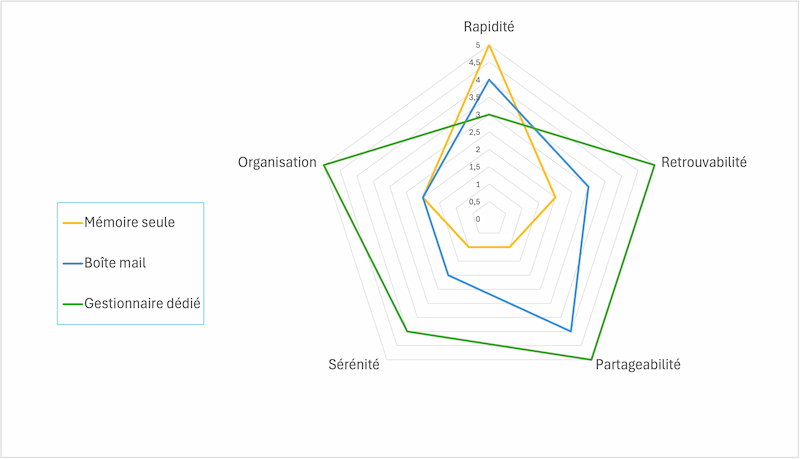
Memory excels where almost nothing is asked of it: logging an intention takes zero seconds - it's the thought itself. But it struggles to retrieve anything from weeks ago, and falls apart when it comes to sharing or relieving mental load. Memory is excellent for 80s song lyrics, and considerably less reliable for commitments made yesterday.
Email is surprisingly decent in some areas: capturing takes a few seconds (an email to yourself), and sharing is fairly easy via forwarding or CC. That's precisely what makes it so hard to give up - it satisfies the visible needs. But it collapses on two less immediate dimensions that matter far more in practice: mental ease and organization. On the latter, it earns the lowest score in the comparison - for a structural reason. Email has no capacity for autonomous organization: the order is dictated by who writes to you, not by what matters. That deficit compounds over time, and no amount of discipline can fix it.
A dedicated task manager isn't the fastest at capturing - there's always a few seconds of interaction where a thought is instantaneous. That's its only real weakness. In return, it leads on every other dimension, especially the two that generate the hidden cost of the default system: organization and mental ease. It doesn't score a perfect ten on mental ease, though: a system requires maintenance and a minimum of discipline. The honest promise isn't eliminating all mental load - it's significantly reducing it compared to the default approach, and making it proportional to the actual amount of work you're carrying, rather than to the fear of forgetting.
How Do You Get Started Without Falling Into Classic Traps?
Recognizing the problem isn't enough. You also need to avoid the common pitfalls.
1. Pick One Tool - Just One
The beginner's trap is testing five apps, keeping a little of each, and ending up with a to-do in one, notes in another, sticky notes on the screen, and still the emails. The result is worse than where you started: you've multiplied the places to check without abandoning any of them.
A mediocre tool used exclusively beats an excellent tool used partially. One place to look.
At the other end of the spectrum, beware of sophistication. A Kanban board with twenty columns and a tangle of labels takes more energy to maintain than to use. A simple system, consistently used, beats a sophisticated one abandoned after three weeks.
2. Capture Immediately
The critical moment is when the idea surfaces: on the commute, in a meeting, in the shower. If you wait for "the right moment" to write it down, it's gone. The tool needs to be accessible everywhere - mobile app, browser, keyboard shortcut - and capture should take seconds. Otherwise, you're back to relying on memory, and you're starting over.
3. Share
With colleagues, clients, vendors, depending on the context. A shared task doesn't carry the same weight as a personal one: commitment increases, the risk of forgetting drops. And the system becomes useful to the whole team, not just to you.
4. Stay Organized - Without Chasing Perfection
Perfection is the enemy of adoption. You just need to be able to answer "what do I start with?" without hesitation. What matters isn't the elegance of your setup, but doing things in the right order - not in the order you think of them, and not in the order they arrive in your inbox.
The shift from a default system to an intentional one doesn't show up in the weeks that follow. It shows up six months later, when you realize you've stopped waking up at 3:00 AM wondering whether you forgot something important. That absence of signal is the real benefit - and it only materializes if you've held to the four principles above long enough for the system to become trustworthy.
Key Takeaways
- Memory and email handle poorly any task that generates no external trigger - renewals, recurring items, follow-ups with no correspondent.
- End-of-day fatigue may partly stem from the mental load of unwritten tasks.
- Email sorts by sender, not by importance: that deficit is structural - better discipline won't fix it.
- Distinguishing between a "project" and a "concrete next action" is the key to breaking out of paralysis in front of a vague list.
- A commitment written in a shared tool carries more weight than a verbal one - visibility changes behavior.
- The most important rule: one tool, used exclusively.