Passphrase: A Password Made of Words - Use It Wisely
A passphrase is a sequence of randomly chosen words, easier to remember than a traditional password. It is only as strong as one strict condition: the words must be genuinely random. Here's how to create one, how many words to aim for, and the rare cases where it's actually the right answer.
What is a passphrase?
A passphrase is a password made up of several whole words chosen at random - for example, "porthole cherry vertigo cauldron plunge barstool." Instead of combining characters, you combine words.
The reference method is called Diceware. It involves randomly selecting several words from a public list of approximately 7,800 words - historically using dice (hence the name), today using a generator. Two points define its value: the words are drawn at random, not chosen, and they have no connection to one another, grammatically or thematically. What makes a passphrase hard to remember is exactly what makes it secure. Any attempt to make it more convenient weakens it.
Is a passphrase strong because it's long?
No. A passphrase is strong because it's randomly generated, not because it's long. The moment it tells a story, its protection collapses.
This is the fundamental misunderstanding. Passphrases are often presented as long, memorable, and very strong - as if those three qualities naturally go together. In reality, only the randomness of the word selection produces security. A phrase invented off the top of your head and a randomly generated passphrase can look identical to the eye: only the method of creation sets them apart.
What is entropy, and why is it the only thing that matters?
Entropy measures how difficult a secret is to guess. It's expressed in bits, and the rule is simple: each additional bit doubles the attacker's workload.
Some reference points:
| Entropy | Number of possibilities | What it means in practice |
|---|---|---|
| 40 bits | one trillion | cracked in minutes offline |
| 60 bits | one million times more | serious, but not out of reach |
| 80 bits | another million times more | beyond the realm of feasibility |
The key distinction: entropy doesn't describe the secret itself - it describes how that secret was chosen. A random generator could produce "hello," and that would be a legitimate draw; a user who types "hello" on their own has no protection whatsoever. What matters is not what the password looks like, but how many possibilities it was drawn from. This is the same principle behind why password length matters more than complexity: adding length multiplies the possibilities, while decorating a password barely helps.
How many words does a secure passphrase need?
Six words at minimum. Seven or eight for a secret that protects everything else, such as the master password for a password manager or disk encryption.
| Words drawn at random | Entropy | Equivalent generated password | Characters to type |
|---|---|---|---|
| 4 words | 52 bits | 8 characters | ~25 |
| 5 words | 65 bits | 10 characters | ~32 |
| 6 words | 78 bits | 12 characters | ~38 |
| 7 words | 90 bits | 14 characters | ~44 |
| 8 words | 103 bits | 16 characters | ~51 |
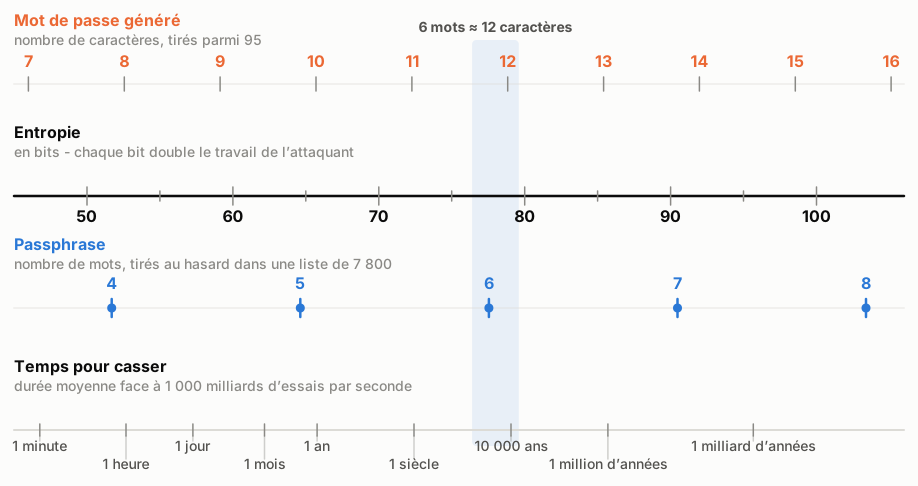
In terms of computation time, against an attacker capable of one trillion attempts per second (a pessimistic assumption, implying a stolen secret with poor server-side protection): four words fall in under an hour, five words hold for a few months, six words for several thousand years, and seven words are out of reach entirely.
Why be more demanding for a master password or disk encryption? Because those are exposed to offline attacks. An attacker who gets hold of them can work at their own pace, with no limit on attempts. No server-side protection can stop them - only the entropy of the secret itself stands in the way.
A useful detail: expanding the word list - that is, choosing uncommon words - is nearly pointless. Going from 7,800 to 20,000 words only gains about one and a half bits per word, because you need to double the list to gain a single bit. The only lever that actually matters is the number of words.
Why does a passphrase need to be longer than a generated password?
Because a word provides less security than it appears to. A word drawn at random from 7,800 options is worth about 13 bits - the equivalent of just two characters - yet it costs five or six keystrokes.
In other words, a passphrase delivers roughly three times less security per character typed than a generated password. This is the one case where displayed length and actual strength diverge significantly. A thirty-five-character passphrase looks impressive visually; it's worth about a twelve-character generated password. The ratio is remarkably consistent: one randomly drawn word is worth roughly two random characters.
Can you use a meaningful phrase to make it easier to remember?
No - this is the most common mistake. In a coherent sentence, each word narrows the field of possible next words instead of multiplying it, which is the exact opposite of what you need.
Take a passphrase that starts with "I went to the..." The first words form a common sequence: they contribute almost nothing, and an attacker will test them immediately. As for the next word, grammar and meaning confine it to a handful of plausible candidates: restaurant, movies, market, office, park. A few dozen options, where random selection would have offered nearly eight thousand.
A meaningful English sentence caps out at around one bit per character, versus 6.5 bits for true randomness. A forty-character meaningful phrase can therefore be worth less than a seven-character generated password. This isn't a theoretical concern: modern cracking tools incorporate language models and prioritize natural word sequences. Song lyrics, proverbs, titles, and famous quotes have been in attack dictionaries for years. Personal memories aren't a workaround: the attacker doesn't need to know your memory - just the language.
Should you add uppercase letters, numbers, and symbols?
There's no need. These decorations add very little to a passphrase, while one additional randomly drawn word changes everything.
| Addition | Actual gain |
|---|---|
| Capitalizing the first word | 0 bits - everyone does it |
| Adding "!" or "1" at the end | 2 to 3 bits |
| An original separator (-, _, .) | approximately 2 bits |
| Replacing letters with symbols (a becomes @) | nearly zero - these substitutions are built into tools |
| Adding one randomly drawn word | +13 bits |
What are the downsides of a passphrase?
Memorization takes real effort, and typing it on a mobile device is cumbersome - especially when characters aren't displayed. These limitations are rarely mentioned, but they determine when a passphrase is actually appropriate.
Memorizing six to eight words with no logical connection between them isn't effortless: it takes genuine work. It's easier than a generated password of equivalent strength, but it's not free. Typing forty characters on a touchscreen keyboard multiple times a day - with autocorrect interfering - is a very real reason people give up. And a character limit of twenty or thirty-two, still common on many sites, can make the approach impossible altogether.
When should you actually use a passphrase?
Only for the rare secrets you need to memorize by heart, because no tool can retrieve them for you. Everywhere else, a generated password does better.
There are only a handful of genuinely good use cases:
- The master password for a password manager
- Disk or backup encryption
- A recovery phrase that cannot be stored anywhere
- A shared secret communicated verbally or over the phone
That last case is a rarely mentioned advantage: a sequence of words can be dictated, written by hand, and copied without error, whereas a generated password turns every 0/O and l/1 into a source of confusion. For everything else - the dozens of everyday accounts - a generated, unique, never-memorized password is better in every way. The real question isn't "passphrase or generated password?" but "do I actually need to memorize this secret?" The answer should rarely be yes in a digital life - especially since passkeys further reduce the number of secrets worth memorizing. The generator built into Octopussian's password manager produces passphrases using the same cryptographic randomness as a traditional generated password.
How do you create a passphrase correctly?
Let a machine draw the words at random, and resist any urge to rearrange them. The entropy lives in the draw, not in how you remember it.
- Don't choose the words yourself. Despite our intuition, humans are poor at choosing randomly. Use dice or a cryptographic generator - not gut feeling.
- Don't re-roll a word you don't like. Rejecting draws you dislike is equivalent to shrinking the list. If the result is truly unworkable, re-generate the entire passphrase - not just one word.
- Don't shorten the word list. With a short list (around 1,300 words), you need about eight words to reach the security that six words provide with the full list.
- A mnemonic trick costs you nothing. Inventing an absurd mental image to remember a random draw doesn't weaken the secret. What's off-limits is composing the phrase from a story.
- Writing the passphrase on paper while you memorize it is a reasonable compromise, as long as you destroy the paper once you have it memorized.
- A passphrase is never reused, just like a regular password. And it doesn't replace a second factor: it protects against guessing, not against phishing, a keylogger, or a server-side data breach.
Key takeaways
- A passphrase is strong because it's randomly generated, not because it's long.
- Six words minimum; seven or eight for a master password or disk encryption.
- Never use a meaningful phrase: every predictable word reduces security.
- One additional random word is worth more than all the uppercase letters, numbers, and symbols combined.
- Passphrases are only for secrets you need to memorize by heart; for everything else, a generator is the better choice.